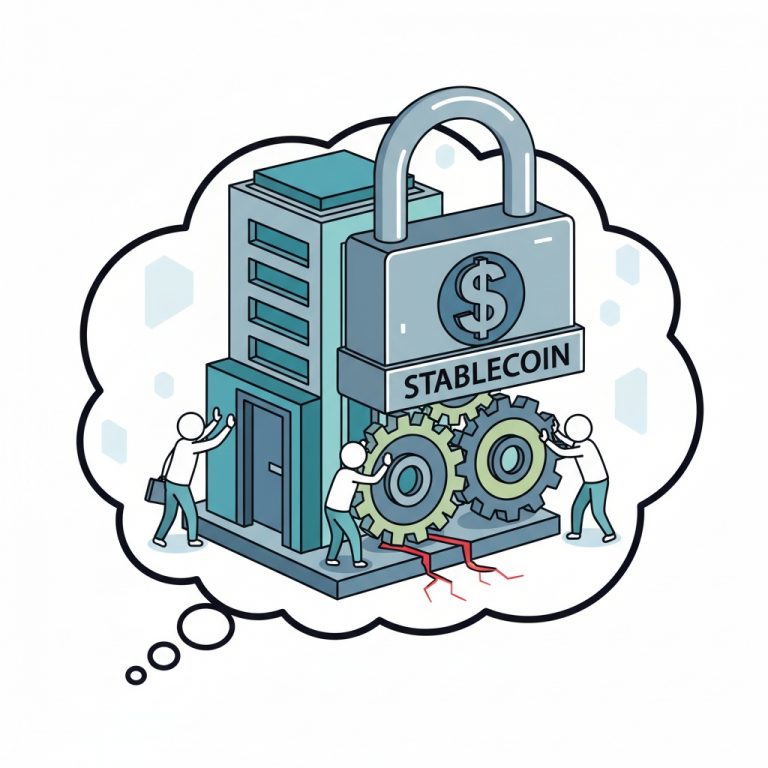
Stablecoins for Businesses: Role in Treasury and International Payments
Reading time: 12 minutes
Ever watched a $50,000 international payment get stuck in correspondent banking limbo for four days while currency fluctuations shaved 3% off its value? That’s the reality many CFOs face daily. Now imagine that same payment settling in minutes with near-zero fees. Welcome to the stablecoin revolution transforming business treasury operations.
Here’s the straight talk: Stablecoins aren’t just crypto speculation vehicles anymore—they’re emerging as serious infrastructure for corporate treasury management and cross-border payments. Whether you’re a mid-sized exporter tired of wire transfer delays or a finance director exploring liquidity optimization, understanding stablecoins has shifted from “nice to know” to “need to know.”
Table of Contents
- What Are Stablecoins and Why Should Businesses Care?
- Revolutionizing Treasury Management
- Transforming International Payments
- Real-World Business Applications
- Navigating Challenges and Practical Solutions
- Your Implementation Roadmap
- Frequently Asked Questions
What Are Stablecoins and Why Should Businesses Care?
Think of stablecoins as the Swiss Army knife of digital finance—combining blockchain speed with traditional currency stability. Unlike Bitcoin’s rollercoaster rides, stablecoins maintain a consistent peg to assets like the US dollar, making them actually usable for business operations.
The numbers tell a compelling story: Stablecoin transaction volume reached $11.6 trillion in 2023, with USDC and USDT processing more daily settlement volume than Mastercard. But volume alone doesn’t explain why forward-thinking treasurers are paying attention.
The Business Value Proposition
Speed meets predictability: Traditional international payments crawl through correspondent banking networks, taking 3-5 business days on average. Stablecoins settle in minutes, 24/7, without banking holidays or cut-off times. Yet unlike volatile cryptocurrencies, they maintain price stability—your $100,000 payment stays $100,000.
Cost efficiency at scale: A typical SWIFT wire transfer costs $30-50 plus 1-3% in FX markups. Stablecoin transfers? Often under $1 in network fees, with transparent pricing and no hidden spreads. For businesses moving millions monthly, these savings compound dramatically.
Types of Stablecoins: What Businesses Need to Know
Not all stablecoins are created equal. Understanding the distinctions matters for risk management:
- Fiat-collateralized stablecoins (USDC, USDT): Backed 1:1 by dollars in bank accounts or short-term treasuries. Most transparent and widely adopted for business use.
- Crypto-collateralized stablecoins (DAI): Backed by cryptocurrency holdings with over-collateralization. More decentralized but complex for traditional finance teams.
- Algorithmic stablecoins: Use code to maintain pegs. Remember TerraUST’s $40 billion collapse? Most businesses rightfully avoid these.
Pro tip: For business treasury applications, stick with regulated, fiat-backed stablecoins with transparent monthly attestations. Circle’s USDC and Paxos’ USDP offer the compliance frameworks corporate finance departments require.
Revolutionizing Treasury Management
Let’s get practical. How are businesses actually using stablecoins in treasury operations today?
Liquidity Management and Working Capital Optimization
Traditional corporate treasury faces a frustrating trade-off: keep cash liquid in low-yield checking accounts, or lock it into short-term investments that sacrifice accessibility. Stablecoins are rewriting this equation.
Quick Scenario: Imagine you’re a software company with $5 million in working capital. In a traditional savings account, you’re earning maybe 0.5-1% annually. Meanwhile, that cash needs to be available for payroll, vendor payments, and opportunity purchases. What do you do?
Several businesses are now using stablecoins as a treasury layer that maintains liquidity while accessing DeFi (Decentralized Finance) yield opportunities. While rates fluctuate, some treasury protocols offer 3-5% yields on stablecoin deposits—competitive with money market funds but with 24/7 accessibility.
Cash Management Across Subsidiaries
Multi-national corporations face a persistent headache: efficiently moving cash between subsidiaries in different countries. Traditional methods involve multiple bank accounts, currency conversions, and delayed settlements.
Real-World Example: Manufacturing Company Treasury Transformation
A European manufacturing company with operations in Asia previously took 5-7 days to rebalance cash between subsidiaries, losing 2-3% to FX spreads on each transfer. After implementing a USDC-based treasury system, they reduced transfer times to same-day, cut costs by 87%, and gained real-time visibility into group-wide liquidity positions. Annual savings: approximately €340,000 on $12 million in quarterly inter-company transfers.
Comparative Analysis: Traditional vs. Stablecoin Treasury Operations
| Aspect | Traditional Banking | Stablecoin Solutions |
|---|---|---|
| Settlement Speed | 3-5 business days | Minutes to hours, 24/7 |
| Transaction Costs | $30-50 + 1-3% FX markup | $0.50-$5 network fee |
| Operating Hours | Business days only | 24/7/365 |
| Transparency | Limited visibility, opaque fees | Complete on-chain transparency |
| Programmability | Limited automation options | Smart contract automation available |
Treasury Yield Strategies
Conservative treasury managers are exploring stablecoin yield strategies that mirror traditional money market approaches but with enhanced returns and liquidity:
- Institutional lending protocols: Platforms like Compound and Aave allow businesses to earn yield by providing liquidity, similar to commercial paper markets but with daily liquidity.
- Tokenized treasury funds: Products like Franklin Templeton’s BENJI token represent traditional money market funds on-chain, combining regulatory compliance with blockchain efficiency.
- Stablecoin rewards programs: Some payment processors offer 1-2% back on stablecoin balances—effectively a high-yield checking account for business operations.
Well, here’s the straight talk: Treasury yield strategies require thorough due diligence. Unlike FDIC-insured accounts, DeFi protocols carry smart contract risks. Start small, prioritize audited protocols with proven track records, and never commit more than you can afford to lose to experimental platforms.
Transforming International Payments
If treasury management is where stablecoins show promise, international payments are where they deliver immediate, measurable impact today.
The Cross-Border Payment Problem
International business payments are stuck in 1970s infrastructure. Your payment bounces between 2-4 correspondent banks, each taking a cut and adding delays. Currency conversion happens through opaque spreads. And when something goes wrong? Good luck tracking it down.
A World Bank study found the global average cost for sending $200 internationally was 6.2%. Scale that to B2B payments in the millions, and you’re looking at substantial friction costs.
Stablecoin Payment Advantages in Practice
Direct settlement without intermediaries: Stablecoins eliminate correspondent banks entirely. Send USDC from New York to Singapore directly, peer-to-peer, with no middleman taking cuts.
24/7 availability: Need to pay a contractor in Brazil on Sunday? Traditional banks say wait until Monday. Stablecoins say “done”—no banking hours, no weekend delays, no holidays.
Transparent, predictable costs: Network fees are published upfront. No hidden FX spreads, no unexpected intermediary charges appearing three days later.
Cost Comparison: International Payment Methods
3.5%
1.8%
0.05%
Based on typical fees for $100,000 international transfer
Supplier and Vendor Payments
Companies with international supply chains are early stablecoin adopters. The use case is straightforward: pay overseas suppliers faster, cheaper, and with full traceability.
Real-World Example: A US-based e-commerce company sources products from manufacturers in Vietnam and Thailand. Previously, payments took 5-7 days via wire transfer with $45 fees per transaction plus 2% FX markup. After switching to USDC payments through a business-focused platform, they:
- Reduced payment time to same-day settlement
- Cut per-transaction costs from $750 to approximately $15 (on $30,000 average payments)
- Improved supplier relationships through faster, more reliable payments
- Gained complete payment traceability through blockchain records
Annual savings exceeded $125,000 on their international payment operations.
Contractor and Employee Payments
The global talent pool is distributed. Your developer might be in Argentina, your designer in Portugal, your support team in the Philippines. Paying them through traditional channels means high fees eat into their take-home pay.
Stablecoins enable direct, low-cost payments to international contractors who can then convert to local currency through increasingly accessible off-ramps—or hold stablecoins as a hedge against local currency volatility.
Pro tip: When implementing stablecoin contractor payments, ensure clear documentation for tax purposes. Provide payment records showing USD values at time of payment, and consider using platforms that automatically generate compliant payment documentation.
Real-World Business Applications
Theory is fine, but how are businesses actually implementing stablecoins today? Let’s examine sector-specific applications.
E-commerce and Digital Goods
Online businesses face unique payment challenges: international customers, instant delivery expectations, and high chargeback rates. Stablecoins address all three.
Several digital product marketplaces now accept stablecoin payments, offering customers lower fees than credit cards (typically 0.5-1% versus 2.5-3.5%) while providing merchants with instant settlement and zero chargeback risk. The irreversible nature of blockchain transactions eliminates fraudulent chargebacks that plague digital goods merchants.
Import/Export and Trade Finance
International trade involves complex payment flows: letters of credit, documentary collections, and extended payment terms. Smart contracts built on stablecoin infrastructure are beginning to automate these processes.
Practical application: Escrow-style smart contracts can hold stablecoin payments, automatically releasing funds when shipping documents are verified on-chain. This reduces counterparty risk for both importers and exporters while eliminating expensive trade finance intermediaries.
Professional Services and Consulting
Global consulting firms and professional service providers are leveraging stablecoins for milestone-based payments. Smart contracts automatically release payments when project milestones are confirmed, reducing administrative overhead and improving cash flow predictability for service providers.
Navigating Challenges and Practical Solutions
Let’s address the elephant in the room: stablecoins aren’t without challenges. But understanding these obstacles—and practical workarounds—is what separates successful implementation from expensive experiments.
Challenge #1: Regulatory Uncertainty and Compliance
The problem: Stablecoin regulations vary dramatically by jurisdiction and continue evolving. What’s compliant today might be restricted tomorrow, and what’s allowed in your jurisdiction might be prohibited where your suppliers operate.
Practical solutions:
- Choose regulated stablecoins: Work with issuers that prioritize regulatory compliance (Circle, Paxos) rather than those fighting regulators (looking at you, Tether’s historical opacity).
- Use licensed service providers: Partner with regulated exchanges and payment processors that handle compliance obligations on your behalf.
- Maintain detailed records: Document every transaction with USD values, business purposes, and counterparty information—treating stablecoin transactions with the same rigor as traditional payments.
- Consult specialists: Work with accountants and legal advisors experienced in digital assets. General practitioners often lack the expertise to advise effectively on this emerging area.
⚠️ Compliance Reality Check: In the US, stablecoin payments generally fall under existing money transmission regulations. In the EU, MiCA (Markets in Crypto-Assets) regulation is creating clearer frameworks. In Asia-Pacific, approaches vary dramatically—Singapore is progressive, China restrictive, others cautiously observing. Always verify local requirements before implementation.
Challenge #2: Counterparty Adoption and On/Off-Ramp Friction
The problem: You’re ready to pay suppliers in stablecoins, but they’re not set up to receive them. Or they can receive them but have no easy way to convert to local currency for operational expenses.
Practical solutions:
- Gradual implementation: Start with willing partners—contractors and suppliers who already understand crypto or face expensive payment friction themselves.
- Use hybrid payment providers: Services like Request Finance, BitPay, and Bitrefill allow you to send stablecoins while recipients can choose to receive traditional currency—you get the benefits without requiring counterparty adoption.
- Offer incentives: Share cost savings with suppliers who accept stablecoins. If you’re saving $500 per transaction, offering $100-200 as an adoption incentive creates win-win scenarios.
- Provide education: Create simple guides for counterparties explaining how to set up wallets, receive payments, and convert to local currency. Reducing friction accelerates adoption.
Challenge #3: Volatility in Price Peg and Counterparty Risk
The problem: While stablecoins aim to maintain $1.00 pegs, they occasionally deviate. USDC briefly de-pegged to $0.87 during the Silicon Valley Bank crisis. For businesses with tight margins, even temporary volatility matters.
Practical solutions:
- Minimize holding time: Use stablecoins as payment rails, not long-term stores of value. Convert fiat to stablecoins immediately before transactions, then recipients convert back quickly.
- Diversify across stablecoins: Don’t put all eggs in one basket. Using multiple stablecoins (USDC, USDP, GUSD) reduces single-point-of-failure risk.
- Monitor transparency: Choose stablecoins with monthly attestations from reputable accounting firms showing full backing. Avoid opaque issuers.
- Set internal policies: Establish maximum holding periods and amounts for stablecoin exposure, just as you would for foreign currency or any treasury instrument.
Your Implementation Roadmap
Ready to explore stablecoins for your business? Here’s your strategic action plan—practical steps to move from curiosity to implementation.
Phase 1: Foundation and Education (Weeks 1-4)
Step 1: Build internal knowledge
Before spending a dollar, invest in education. Your finance team needs to understand blockchain basics, how stablecoins work, and what risks exist. Consider:
- Hosting educational sessions with your accounting and treasury teams
- Engaging consultants specializing in digital asset treasury management
- Reviewing case studies from businesses in similar industries
Step 2: Assess your use cases
Not every business benefits equally from stablecoins. Ideal candidates typically have:
- High volumes of international payments (especially to the same countries repeatedly)
- Time-sensitive payment requirements
- Counterparties in countries with expensive banking infrastructure
- Tolerance for emerging technology adoption
Step 3: Evaluate regulatory positioning
Consult with legal and compliance professionals to understand your regulatory obligations. Different industries face different scrutiny—financial services firms need more robust frameworks than software companies.
Phase 2: Pilot Program (Weeks 5-12)
Step 4: Start small and controlled
Launch with a limited pilot program:
- Select 1-3 willing suppliers or contractors for initial stablecoin payments
- Start with small transaction amounts ($1,000-$10,000 range)
- Use established, regulated service providers rather than building custom infrastructure
- Document everything: costs, timing, challenges, counterparty feedback
Step 5: Set up operational infrastructure
For a pilot program, you’ll need:
- Corporate account with a regulated exchange (Coinbase, Kraken, Bitstamp for businesses)
- Treasury wallet solution with appropriate security controls (multi-signature requirements, etc.)
- Accounting integration for proper transaction recording
- Clear internal policies on who authorizes transactions and how they’re documented
Pro tip: Don’t self-custody for business operations until you have robust security infrastructure. Most businesses are better served using institutional custody services that provide insurance and security guarantees.
Phase 3: Evaluation and Scaling (Weeks 13-24)
Step 6: Measure and analyze
After 2-3 months of pilot operations, conduct thorough analysis:
- Total cost savings compared to traditional methods
- Time savings in payment processing and reconciliation
- Counterparty satisfaction and any friction points
- Internal administrative burden (is it simpler or more complex?)
- Any compliance or regulatory issues encountered
Step 7: Decision point and scaling
Based on pilot results, decide whether to:
- Scale up: Expand to more counterparties and larger transaction amounts
- Refine approach: Continue pilot with adjustments based on learnings
- Pause or discontinue: If benefits don’t justify complexity for your situation
If scaling, gradually increase both transaction volume and the number of counterparties. Implement robust treasury controls as volumes grow—what works for $50,000 monthly doesn’t suffice for $5 million.
Essential Technology Partners
You don’t need to build everything yourself. Leverage existing platforms designed for business stablecoin operations:
- Payment processors: Bitpay, Request Finance, Coinbase Commerce—accept stablecoin payments from customers
- Treasury management: Gnosis Safe, Fireblocks—secure custody and transaction management
- Accounting integration: Cryptio, Gilded—connect stablecoin transactions to your accounting system
- On/off-ramp providers: Circle Account, Coinbase Prime—efficiently convert between fiat and stablecoins
Frequently Asked Questions
Are stablecoins actually safe for business treasury operations?
The safety of stablecoins depends primarily on which stablecoin you choose and how you use it. Regulated, transparently-backed stablecoins like USDC and USDP from established issuers are generally safe for business operations when used appropriately—meaning as payment rails rather than long-term value storage. These stablecoins maintain regular attestations from major accounting firms confirming full backing. However, they’re not FDIC-insured, so businesses should treat them like they would cash in transit: use them for operational flows, not idle capital storage. The key is minimizing holding periods and working with regulated custodians that provide insurance coverage for digital asset holdings.
How do stablecoin payments get reported for tax purposes?
Stablecoin payments are treated as taxable events in most jurisdictions, similar to foreign currency transactions. In the US, businesses must report the fair market value in USD at the time of each transaction. Practically, since stablecoins maintain $1 pegs, this is straightforward—a $10,000 USDC payment is reported as a $10,000 transaction. However, you must maintain detailed records including transaction hashes, counterparty information, timestamps, and business purposes. Many businesses use specialized crypto accounting software like Cryptio or Gilded that automatically calculate gains/losses and generate necessary tax documentation. The critical point: stablecoin transactions require the same documentation rigor as traditional payments, and working with an accountant experienced in digital assets is highly advisable during implementation.
What happens if a stablecoin loses its peg while I’m holding it?
Temporary de-pegging events have occurred—USDC briefly dropped to $0.87 during the SVB crisis before recovering. If you’re holding stablecoins when de-pegging occurs, you face temporary mark-to-market losses. However, well-backed stablecoins historically return to peg quickly. To minimize this risk, businesses should: (1) minimize holding periods by converting fiat to stablecoins immediately before transactions, (2) diversify across multiple stablecoins rather than concentrating in one, (3) establish maximum holding amounts in internal policies, and (4) choose stablecoins with strong backing transparency. Think of stablecoins like checks in transit—you’re exposed during the brief period between writing and clearing, but proper controls minimize risk. For extended treasury applications, more conservative businesses use tokenized money market funds that combine blockchain efficiency with traditional investment-grade backing.
Building Your Stablecoin Strategy: Next Steps
The stablecoin revolution in business payments isn’t coming—it’s here. Companies processing millions in international payments are already saving hundreds of thousands annually. Treasury managers are accessing better yields with maintained liquidity. Supply chains are settling faster with lower friction.
Your immediate action items:
- Calculate your potential impact: Total your annual international payment volumes and multiply by 2-3%. That’s your approximate current friction cost—and your potential savings opportunity.
- Identify your best use case: Where do you face the most payment pain? High-frequency payments to the same overseas suppliers? Weekend payment needs? Extended settlement times hurting cash flow? Start there.
- Build your knowledge team: Schedule meetings with your CFO, controller, and legal counsel. Share this article. Begin building internal alignment around a controlled exploration.
- Connect with implementation partners: Reach out to 2-3 regulated service providers for consultations. Most offer free assessments to help determine if stablecoins fit your situation.
- Design your pilot parameters: Define success metrics, transaction limits, counterparty selection, and timeline before spending a dollar. Pilots without clear goals become expensive experiments.
The businesses thriving with stablecoins aren’t necessarily the most technically sophisticated—they’re the ones that approached implementation strategically, learned from controlled experiments, and scaled what worked while abandoning what didn’t.
A final thought: Payment infrastructure rarely changes overnight, but when it does, early adopters gain disproportionate advantages. The SWIFT network launched in 1973 and took decades to dominate. Stablecoins are on a much faster trajectory. The question isn’t whether blockchain-based payments will become mainstream business infrastructure—it’s whether you’ll be positioned to benefit when they do.
What’s the one international payment that frustrates you most each month? That’s probably your starting point for stablecoin exploration. The treasury operations of tomorrow are being built today—will your business be leading or catching up?

Artigo revisto por Alessandro Conti, Especialista em resolução e reestruturação bancária, em November 13, 2025